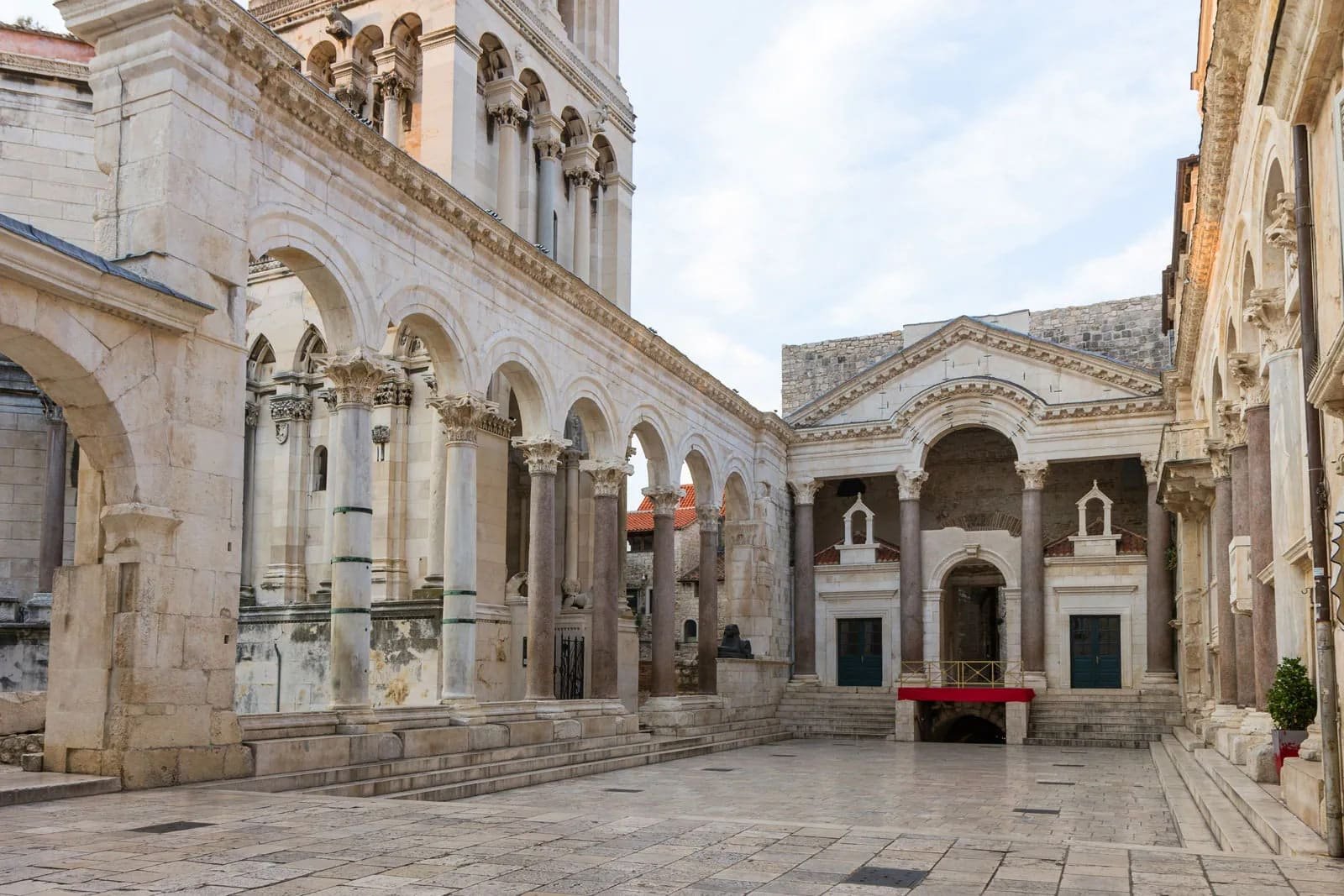
Explore a Roman emperor’s palace that is still a town
Diocletian built his retirement palace here around AD 305. Sixteen centuries later people never stopped living in it — there are flats, bars and a cathedral inside the walls, and the old Roman street plan is still the street plan.
What makes Split unusual among Roman sites is that it was never abandoned and never excavated into a ruin. When Salona fell in the seventh century its refugees moved into the empty palace and simply built into it. The result is a working quarter of the city where a Roman wall is somebody’s kitchen wall.
The set pieces are the Peristyle, the colonnaded courtyard at the centre where Diocletian appeared to his subjects; the cathedral of Saint Domnius, which was his mausoleum before it was a church — and is dedicated to a martyr he had executed; and the vast substructures beneath, which held the palace up and now hold market stalls.
A guide is worth having here specifically because the layers are hard to read alone. Roman, Venetian, Napoleonic and modern are stacked in the same doorway, and without someone to separate them it can read as simply old.
Good to Know
Availability, exact timings and pricing depend on your itinerary, hotel and season — your Finders & Keepers Safaris specialist will confirm details and slot this experience into your existing day-by-day plan.
It is a living quarter, not a monument
People live and work inside the palace walls, so the ordinary courtesies apply — keep noise down in the residential lanes and do not photograph into doorways. The substructures are cool even in August, which makes them the right stop for the middle of a hot day. Sturdy shoes: the Roman paving is polished to a shine and genuinely slippery.